
In short: BoXy glass doors and walls combine certified acoustic insulation performance — up to 52 dB for doors, R’w ≥ 45 dB for walls — with an all-glass design. They are designed for recording studios, control rooms, broadcast spaces, and educational environments where sound quality cannot compromise aesthetics. In this article, discover how they work and what makes them unique.
Think about the last time you saw a large recording studio: there is almost always a large window between the control room and the recording space. That glass seems like the classic weak point of any acoustic project, yet it can become one of the most performing elements of the entire environment if designed with the right technology.
The problem is that most available solutions force you to choose: either acoustic performance or design. BoXy has decided that this choice should not exist.
With the BoXy modular system, glass doors and walls achieve certified insulation levels that surpass traditional double-door solutions, without sacrificing an inch of aesthetic vision. Here’s how they work and why this technology is changing the way professional acoustic environments are designed.
Why is glass traditionally considered a weak point in acoustic insulation?
 Glass is a rigid material. This makes it more vulnerable to certain frequencies than others, and for this reason, standard glass has never been a serious acoustic solution in professional environments.
Classic solutions involved double frames with wide air chambers and angled glass to shift critical resonance frequencies. It works, but it requires space and often produces an aesthetically unpleasing result.
BoXy has found a different path: recording studios, broadcast, and post-production can finally have glass without the compromises of the past.
How do BoXy all-glass doors work?
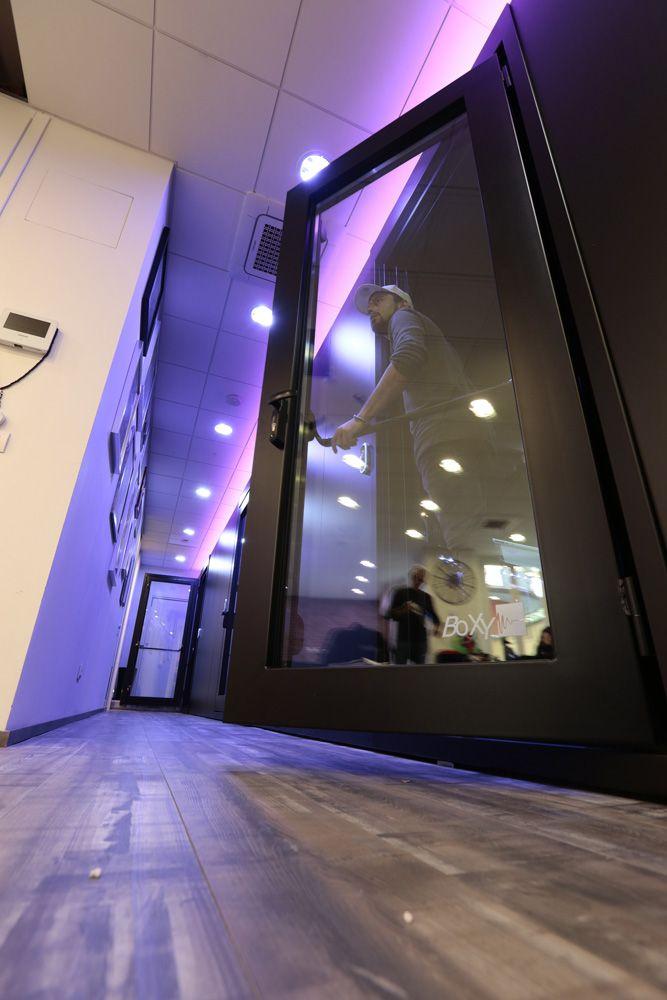
BoXy doors are entirely made of glass and achieve acoustic insulation of up to 52 dB, surpassing traditional double-door solutions. The BoXy design team selects the most suitable type of glass for each specific application: low-frequency monoliths for environments with a lot of energy in the deeper bands, laminated glass, or solutions that exploit the vibrating behavior of glass as a dissipative element.
Performance is not declared on paper: it is measured by accredited ACCREDIA acoustic technicians on real BoXy models, with values of R’w ≥ 45 dB and RT (500Hz) = 0.3 sec (±0.2 sec). This is the difference between a marketing promise and an engineering guarantee with RINA certification.
What are BoXy glass walls and what distinguishes them?
BoXy glass walls promote natural light, enhance the livability of spaces, and contribute to a diffuse and bright acoustics within the environment. They are not just a separator between two rooms: they are an element that actively improves the perceived quality of the space from both sides.
The design team selects the most suitable glass for each need: from mastering rooms where low frequencies dominate, to broadcast studios where intelligibility is a priority, to educational environments where long-term comfort is a critical parameter. The result is visible in the projects completed by BoXy around the world.


In which environments are BoXy glass doors and walls used?
In recording and mastering studios, the glass wall between the control room and the recording space is a standard element. With BoXy, this wall stops being a compromise and becomes a certified component of the acoustic system: the artist sees the sound engineer, the sound engineer monitors the artist, and the sound stays where it should.
In the broadcast and post-production field, the isolation requirements are extremely high, and BoXy doors ensure the necessary seal even in intense operational contexts.
In educational contexts, such as conservatories and music schools, BoXy glass walls allow for visual supervision between separate environments without losing the necessary acoustic insulation.
For architects and designers, BoXy provides the BOXYCAD library for Autodesk Autocad, which allows for the integration of glass components into the project from the early stages with certified performance values.
The BoXy modular system: why do glass doors and walls belong to an integrated system?
Acoustics work for systems, not for individual components. Doors, glass walls, structural modules, and the BOXYGEN ventilation system are designed and certified as a unified system. The interfaces between components are part of the design, not a problem to be solved on-site.
The self-supporting BoXy structure — which creates a “box within a box” ensuring structural decoupling — can be expanded, disassembled, and reinstalled without altering acoustic performance. A long-term investment that adapts over time, with the guarantee of RINA certification.
How is an acoustic environment designed with BoXy glass walls?
The process begins long before the construction site. The BoXy team works alongside architects and designers from the conceptual phase, analyzing space usage and selecting the most suitable components. For glass walls, this phase includes choosing the type of glass based on the critical frequency spectrum for that specific application.
BoXy provides the BOXYCAD library for those who want to work independently, or an internal design service for those who prefer to rely on the team. The result is a project in which each component is sized and certified based on the final performance.
The average installation of a BoXy system takes about 10 days, compared to the typical 4 months of traditional construction. Fewer operational interruptions, reduced construction costs, and an environment ready for use in timelines that the traditional market cannot guarantee.
Conclusion: glass is not a compromise, it is a technical choice
For years, glass in professional acoustic environments has been tolerated as a functional necessity, accepted as a weak point to be mitigated. BoXy has changed this narrative: with all-glass doors up to 52 dB and certified glass walls with values of R’w ≥ 45 dB, glass becomes one of the most performing elements of the entire acoustic system, and one of the most beautiful.
If you are designing a recording studio, a control room, a broadcast space, or an educational environment and want to know how BoXy glass doors and walls integrate into your specific project, contact the BoXy team for personalized advice.
